Filter sites
Tradition
Site type
Region
Era

Site of the Buddha's enlightenment under the Bodhi Tree. The Mahabodhi Temple Complex is one of the four holiest sites in Buddhism and a UNESCO World Heritage Site.

Commissioned by Emperor Ashoka, the Great Stupa at Sanchi is the oldest surviving stone stupa in India, renowned for its intricately carved gateways (toranas). A UNESCO World Heritage Site.

Marks the Deer Park where the Buddha delivered his first sermon. The Dhamek Stupa remains an active pilgrimage and monastic site alongside Ashoka's lion-capital pillar.

Traditional site of the Buddha's parinirvana (death). A large reclining Buddha statue inside the Mahaparinirvana Temple and the nearby Ramabhar Stupa (his cremation site) make this one of Buddhism's four main pilgrimage places.

One of the tallest and largest stupas in the world at roughly 32 meters, raised near the spot tradition holds the Buddha gave his begging bowl to the grieving Licchavis of Vaishali before his final journey.

Ruins of one of the world's oldest residential universities and a major center of Mahayana Buddhist learning for over 700 years until its destruction in the 1190s. A UNESCO World Heritage Site.

A modern Japanese-built World Peace Pagoda on Ratnagiri hill above Rajgir, reached by a ropeway, overlooking the ancient city where the Buddha spent much time and the First Buddhist Council was held nearby.

Site where a portion of the Buddha's bodily relics, originally enshrined by the Licchavis after his cremation, were found in a stone casket in 1958 — one of the earliest-attested relic stupas in Buddhist history.

Once one of the largest stupas in India and a key center of early Mahayana philosophy on the Krishna river. Many of its famed carved marble panels are now in the British Museum and Chennai’s Government Museum.

An ancient stupa near the Nepal border where a relic casket inscribed as containing a share of the Buddha's bodily remains was excavated in 1898 — among the most significant and debated Buddhist relic finds.

Built jointly by Indian and Japanese Buddhist groups, this stupa overlooks the Daya river battlefield where Emperor Ashoka is said to have renounced warfare after the Kalinga War and turned to Buddhism.

The birthplace of the Buddha, marked by the Maya Devi Temple, a sacred pond, and an Ashokan pillar inscribed to confirm the site. A UNESCO World Heritage Site surrounded by monasteries built by Buddhist nations worldwide.

An ancient hilltop stupa overlooking Kathmandu, its painted eyes watching the four cardinal directions. A UNESCO World Heritage Site and one of the holiest Vajrayana Buddhist sites in Nepal.

One of the largest spherical stupas in the world and the center of Tibetan Buddhist life in Kathmandu, surrounded by monasteries of many Tibetan lineages. A UNESCO World Heritage Site.

A gleaming white dagoba in the sacred city of Anuradhapura, said to enshrine a bowl of the Buddha's relics. Part of the Anuradhapura UNESCO World Heritage Site and still an active site of Theravada worship.

Once one of the tallest brick structures in the ancient world at roughly 120 meters, built for the Mahayana-leaning Jetavana fraternity in otherwise Theravada Anuradhapura. Part of the same UNESCO sacred city.

Enshrines what is venerated as the Buddha's left canine tooth relic, historically tied to the right to rule Sri Lanka. A UNESCO World Heritage Site in Kandy and one of Theravada Buddhism's most important pilgrimage destinations.

Traditionally the hill where King Devanampiya Tissa met the monk Mahinda and Buddhism was first introduced to Sri Lanka in the 3rd century BCE. A major pilgrimage and monastic ruin site.

A complex of five cave shrines carved into a granite outcrop, holding Sri Lanka's best-preserved ancient Buddhist murals and over 150 Buddha statues. A UNESCO World Heritage Site.

Grown from a cutting of the original Bodhi Tree at Bodh Gaya and planted in 288 BCE, this is the oldest continuously documented and tended tree in the world and one of the most sacred sites in Sri Lankan Buddhism.

A 99-meter gold-plated stupa said to enshrine relics of four past Buddhas, including eight hairs of the historical Buddha. The holiest Buddhist site in Myanmar and the spiritual heart of Yangon.

Home to the heavily gold-leafed Mahamuni Buddha image, one of the most venerated Buddha images in Myanmar, with a daily pre-dawn face-washing ceremony performed by monks.

Widely regarded as the most beautiful of Bagan's temples, with four standing Buddha images and glazed green tiles, sitting within the Bagan Archaeological Zone, a UNESCO World Heritage Site since 2019.

A gilded stupa said to enshrine a bone and tooth relic of the Buddha, begun by King Anawrahta and completed by Kyansittha. It became the prototype for later Burmese stupa design, within the Bagan UNESCO zone.

A gold-leafed granite boulder balanced on a cliff edge, topped by a small stupa said to contain a Buddha hair relic — one of Myanmar's most important pilgrimage sites.

A gilded chedi on a mountain above Chiang Mai, said to enshrine a Buddha relic for which a legendary white elephant chose the site by walking until it died. One of northern Thailand’s most sacred temples.

Within Bangkok's Grand Palace, this royal temple enshrines the Emerald Buddha, Thailand's most sacred and politically symbolic Buddha image, carved from green jasper.

At nearly 120 meters, among the tallest stupas in the world, marking what is traditionally considered one of the earliest sites where Buddhism took root in Thailand.

Originally a Hindu temple to Vishnu, Angkor Wat was gradually converted to Theravada Buddhist use by the 14th century and remains an active Buddhist site today. Part of the Angkor UNESCO World Heritage Site.

The state temple of King Jayavarman VII, a devout Mahayana Buddhist, famous for its 200-plus serene stone faces believed to represent the bodhisattva Avalokiteshvara. Part of the Angkor UNESCO World Heritage Site.

The national symbol of Laos, a gold-covered stupa said to enshrine a breastbone relic of the Buddha brought from India in the 3rd century BCE. The focus of the annual That Luang Festival.

The largest Buddhist monument on Earth — a massive stepped mandala of nine stacked platforms topped by 72 Buddha statues inside perforated stupas. A UNESCO World Heritage Site.

The oldest and tallest pagoda in Hue, its seven-tiered Phuoc Duyen tower an iconic symbol of the former imperial capital, and historically linked to Buddhist activism in 20th-century Vietnam.

Houses a finger bone relic of the Buddha, among the most venerated Buddhist relics in East Asia, rediscovered in a sealed underground crypt in 1987 along with a trove of Tang-dynasty treasures, now enshrined beneath a modern 148-meter stupa.

One of China's largest and wealthiest Chan Buddhist temples, set in wooded hills outside Hangzhou near the Feilai Feng cliff carvings of Buddhist figures.

Over 100,000 Buddhist statues carved into limestone cliffs along the Yi River, including the monumental Vairocana Buddha at the Fengxian Temple grotto. A UNESCO World Heritage Site.

A 71-meter seated Maitreya Buddha carved into a cliff face above the Min River, the tallest stone Buddha statue in the world. Part of the Mount Emei UNESCO World Heritage Site.

The birthplace of Chan (Zen) Buddhism in China and the legendary origin of Shaolin kung fu, set at the foot of Mount Song.

Built to house Buddhist sutras and figurines that the monk Xuanzang brought back from India, this brick pagoda is one of China’s best-preserved examples of Tang-dynasty architecture.

Home to the Daibutsu, a 15-meter bronze seated Buddha and one of the largest bronze Buddha statues in the world, housed in what remains one of the largest wooden buildings on Earth. Part of the Historic Monuments of Ancient Nara UNESCO site.

Founded by Prince Shotoku, Hōryū-ji's five-story pagoda and main hall are considered the oldest surviving wooden buildings in the world — the first UNESCO World Heritage Site registered in Japan.

Tokyo’s oldest and most visited Buddhist temple, dedicated to the bodhisattva Kannon, fronted by the famous Kaminarimon ("Thunder Gate") and the bustling Nakamise shopping street.

One of the finest examples of Silla-dynasty Buddhist architecture, home to several of Korea's National Treasures including the Seokgatap and Dabotap stone pagodas. A UNESCO World Heritage Site paired with the nearby Seokguram Grotto.

Home to the Tripitaka Koreana, over 81,000 carved wooden printing blocks containing the complete Buddhist canon, preserved for nearly 800 years in specially designed storage halls. A UNESCO World Heritage Site.
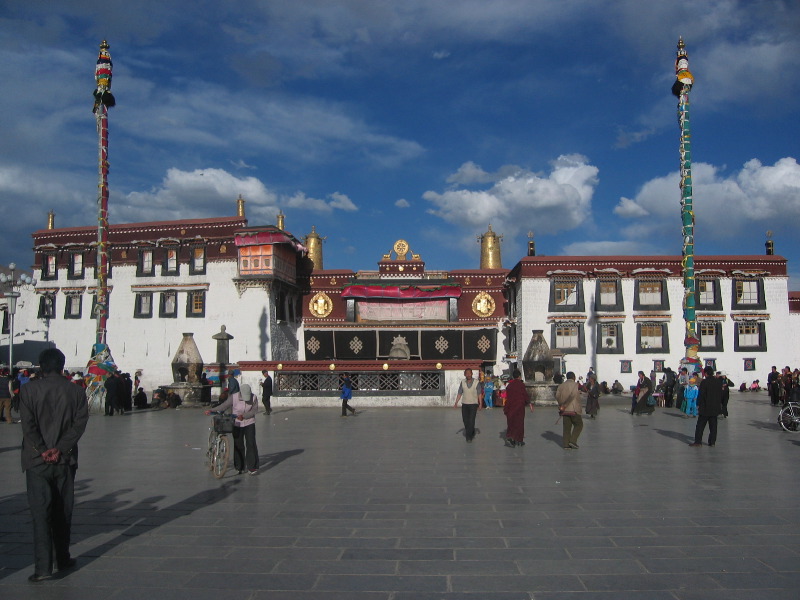
Considered the most sacred temple in Tibetan Buddhism, said to have been built to house a statue of the Buddha brought by a Nepali princess in the 7th century. The spiritual center of Lhasa and endpoint of pilgrimage circuits (koras).

The winter palace of the Dalai Lamas, a vast complex of halls and chapels holding the tombs and relics of past Dalai Lamas. A UNESCO World Heritage Site and the iconic symbol of Tibetan Buddhism.

Traditional seat of the Panchen Lama, Tibet's second-highest-ranking lama, housing a 26-meter gilded statue of the Maitreya Buddha, one of the largest gilded copper statues in the world.

This monastery clings to a cliff face 900 meters above the Paro valley, built at the cave where Guru Padmasambhava is said to have meditated after flying there on a tigress. Bhutan's most iconic Buddhist site.

One of the oldest surviving Buddhist monasteries in Mongolia, built partly from stones of the ruined Mongol imperial capital Karakorum. Part of the Orkhon Valley UNESCO World Heritage landscape.

Mongolia's leading center of Vajrayana Buddhism, home to a 26.5-meter gilded statue of Migjid Janraisig (Avalokiteshvara) and one of the few monasteries that continued functioning through the Soviet-era suppression of religion.
All curated sites
Site of the Buddha's enlightenment under the Bodhi Tree. The Mahabodhi Temple Complex is one of the four holiest sites in Buddhism and a UNESCO World Heritage Site.
Commissioned by Emperor Ashoka, the Great Stupa at Sanchi is the oldest surviving stone stupa in India, renowned for its intricately carved gateways (toranas). A UNESCO World Heritage Site.
Marks the Deer Park where the Buddha delivered his first sermon. The Dhamek Stupa remains an active pilgrimage and monastic site alongside Ashoka's lion-capital pillar.
Traditional site of the Buddha's parinirvana (death). A large reclining Buddha statue inside the Mahaparinirvana Temple and the nearby Ramabhar Stupa (his cremation site) make this one of Buddhism's four main pilgrimage places.
One of the tallest and largest stupas in the world at roughly 32 meters, raised near the spot tradition holds the Buddha gave his begging bowl to the grieving Licchavis of Vaishali before his final journey.
Ruins of one of the world's oldest residential universities and a major center of Mahayana Buddhist learning for over 700 years until its destruction in the 1190s. A UNESCO World Heritage Site.
A modern Japanese-built World Peace Pagoda on Ratnagiri hill above Rajgir, reached by a ropeway, overlooking the ancient city where the Buddha spent much time and the First Buddhist Council was held nearby.
Site where a portion of the Buddha's bodily relics, originally enshrined by the Licchavis after his cremation, were found in a stone casket in 1958 — one of the earliest-attested relic stupas in Buddhist history.
Once one of the largest stupas in India and a key center of early Mahayana philosophy on the Krishna river. Many of its famed carved marble panels are now in the British Museum and Chennai’s Government Museum.
An ancient stupa near the Nepal border where a relic casket inscribed as containing a share of the Buddha's bodily remains was excavated in 1898 — among the most significant and debated Buddhist relic finds.
Built jointly by Indian and Japanese Buddhist groups, this stupa overlooks the Daya river battlefield where Emperor Ashoka is said to have renounced warfare after the Kalinga War and turned to Buddhism.
The birthplace of the Buddha, marked by the Maya Devi Temple, a sacred pond, and an Ashokan pillar inscribed to confirm the site. A UNESCO World Heritage Site surrounded by monasteries built by Buddhist nations worldwide.
An ancient hilltop stupa overlooking Kathmandu, its painted eyes watching the four cardinal directions. A UNESCO World Heritage Site and one of the holiest Vajrayana Buddhist sites in Nepal.
One of the largest spherical stupas in the world and the center of Tibetan Buddhist life in Kathmandu, surrounded by monasteries of many Tibetan lineages. A UNESCO World Heritage Site.
A gleaming white dagoba in the sacred city of Anuradhapura, said to enshrine a bowl of the Buddha's relics. Part of the Anuradhapura UNESCO World Heritage Site and still an active site of Theravada worship.
Once one of the tallest brick structures in the ancient world at roughly 120 meters, built for the Mahayana-leaning Jetavana fraternity in otherwise Theravada Anuradhapura. Part of the same UNESCO sacred city.
Enshrines what is venerated as the Buddha's left canine tooth relic, historically tied to the right to rule Sri Lanka. A UNESCO World Heritage Site in Kandy and one of Theravada Buddhism's most important pilgrimage destinations.
Traditionally the hill where King Devanampiya Tissa met the monk Mahinda and Buddhism was first introduced to Sri Lanka in the 3rd century BCE. A major pilgrimage and monastic ruin site.
A complex of five cave shrines carved into a granite outcrop, holding Sri Lanka's best-preserved ancient Buddhist murals and over 150 Buddha statues. A UNESCO World Heritage Site.
Grown from a cutting of the original Bodhi Tree at Bodh Gaya and planted in 288 BCE, this is the oldest continuously documented and tended tree in the world and one of the most sacred sites in Sri Lankan Buddhism.
A 99-meter gold-plated stupa said to enshrine relics of four past Buddhas, including eight hairs of the historical Buddha. The holiest Buddhist site in Myanmar and the spiritual heart of Yangon.
Home to the heavily gold-leafed Mahamuni Buddha image, one of the most venerated Buddha images in Myanmar, with a daily pre-dawn face-washing ceremony performed by monks.
Widely regarded as the most beautiful of Bagan's temples, with four standing Buddha images and glazed green tiles, sitting within the Bagan Archaeological Zone, a UNESCO World Heritage Site since 2019.
A gilded stupa said to enshrine a bone and tooth relic of the Buddha, begun by King Anawrahta and completed by Kyansittha. It became the prototype for later Burmese stupa design, within the Bagan UNESCO zone.
A gold-leafed granite boulder balanced on a cliff edge, topped by a small stupa said to contain a Buddha hair relic — one of Myanmar's most important pilgrimage sites.
A gilded chedi on a mountain above Chiang Mai, said to enshrine a Buddha relic for which a legendary white elephant chose the site by walking until it died. One of northern Thailand’s most sacred temples.
Within Bangkok's Grand Palace, this royal temple enshrines the Emerald Buddha, Thailand's most sacred and politically symbolic Buddha image, carved from green jasper.
At nearly 120 meters, among the tallest stupas in the world, marking what is traditionally considered one of the earliest sites where Buddhism took root in Thailand.
Originally a Hindu temple to Vishnu, Angkor Wat was gradually converted to Theravada Buddhist use by the 14th century and remains an active Buddhist site today. Part of the Angkor UNESCO World Heritage Site.
The state temple of King Jayavarman VII, a devout Mahayana Buddhist, famous for its 200-plus serene stone faces believed to represent the bodhisattva Avalokiteshvara. Part of the Angkor UNESCO World Heritage Site.
The national symbol of Laos, a gold-covered stupa said to enshrine a breastbone relic of the Buddha brought from India in the 3rd century BCE. The focus of the annual That Luang Festival.
The largest Buddhist monument on Earth — a massive stepped mandala of nine stacked platforms topped by 72 Buddha statues inside perforated stupas. A UNESCO World Heritage Site.
The oldest and tallest pagoda in Hue, its seven-tiered Phuoc Duyen tower an iconic symbol of the former imperial capital, and historically linked to Buddhist activism in 20th-century Vietnam.
Houses a finger bone relic of the Buddha, among the most venerated Buddhist relics in East Asia, rediscovered in a sealed underground crypt in 1987 along with a trove of Tang-dynasty treasures, now enshrined beneath a modern 148-meter stupa.
One of China's largest and wealthiest Chan Buddhist temples, set in wooded hills outside Hangzhou near the Feilai Feng cliff carvings of Buddhist figures.
Over 100,000 Buddhist statues carved into limestone cliffs along the Yi River, including the monumental Vairocana Buddha at the Fengxian Temple grotto. A UNESCO World Heritage Site.
A 71-meter seated Maitreya Buddha carved into a cliff face above the Min River, the tallest stone Buddha statue in the world. Part of the Mount Emei UNESCO World Heritage Site.
The birthplace of Chan (Zen) Buddhism in China and the legendary origin of Shaolin kung fu, set at the foot of Mount Song.
Built to house Buddhist sutras and figurines that the monk Xuanzang brought back from India, this brick pagoda is one of China’s best-preserved examples of Tang-dynasty architecture.
Home to the Daibutsu, a 15-meter bronze seated Buddha and one of the largest bronze Buddha statues in the world, housed in what remains one of the largest wooden buildings on Earth. Part of the Historic Monuments of Ancient Nara UNESCO site.
Founded by Prince Shotoku, Hōryū-ji's five-story pagoda and main hall are considered the oldest surviving wooden buildings in the world — the first UNESCO World Heritage Site registered in Japan.
Tokyo’s oldest and most visited Buddhist temple, dedicated to the bodhisattva Kannon, fronted by the famous Kaminarimon ("Thunder Gate") and the bustling Nakamise shopping street.
One of the finest examples of Silla-dynasty Buddhist architecture, home to several of Korea's National Treasures including the Seokgatap and Dabotap stone pagodas. A UNESCO World Heritage Site paired with the nearby Seokguram Grotto.
Home to the Tripitaka Koreana, over 81,000 carved wooden printing blocks containing the complete Buddhist canon, preserved for nearly 800 years in specially designed storage halls. A UNESCO World Heritage Site.
Considered the most sacred temple in Tibetan Buddhism, said to have been built to house a statue of the Buddha brought by a Nepali princess in the 7th century. The spiritual center of Lhasa and endpoint of pilgrimage circuits (koras).
The winter palace of the Dalai Lamas, a vast complex of halls and chapels holding the tombs and relics of past Dalai Lamas. A UNESCO World Heritage Site and the iconic symbol of Tibetan Buddhism.
Traditional seat of the Panchen Lama, Tibet's second-highest-ranking lama, housing a 26-meter gilded statue of the Maitreya Buddha, one of the largest gilded copper statues in the world.
This monastery clings to a cliff face 900 meters above the Paro valley, built at the cave where Guru Padmasambhava is said to have meditated after flying there on a tigress. Bhutan's most iconic Buddhist site.
One of the oldest surviving Buddhist monasteries in Mongolia, built partly from stones of the ruined Mongol imperial capital Karakorum. Part of the Orkhon Valley UNESCO World Heritage landscape.
Mongolia's leading center of Vajrayana Buddhism, home to a 26.5-meter gilded statue of Migjid Janraisig (Avalokiteshvara) and one of the few monasteries that continued functioning through the Soviet-era suppression of religion.